Technology
How ZF Software-Defined Chassis Impact Aftermarket Tuning
ZF's shift toward software-defined vehicles redefines chassis tuning. Explore how centralized control and by-wire systems impact independent tuning workshops.
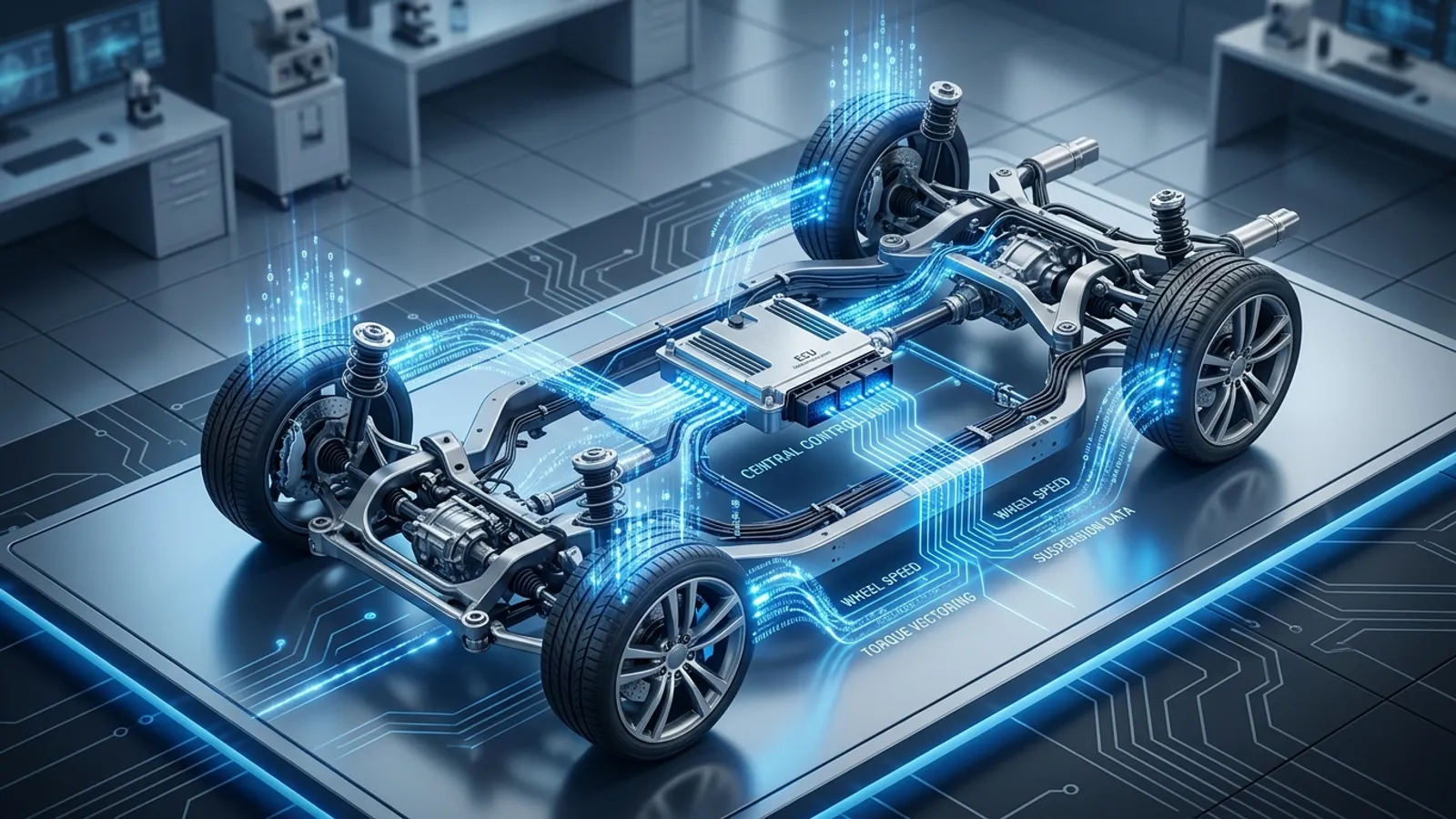
ZF's shift toward software-defined vehicles redefines chassis tuning. Explore how centralized control and by-wire systems impact independent tuning workshops.
The automotive industry is undergoing a structural transition where hardware is increasingly commoditized, and vehicle behavior is dictated by sophisticated software layers. As a leading Tier 1 supplier, ZF showed a suite of chassis products designed for software-defined vehicles (SDVs) at IAA Mobility in Munich in September 2025 (Design News). This development represents a significant shift for the independent tuning sector, moving the focus from physical component replacement to complex software calibration and middleware integration.
The Architecture of ZF Software-Defined Chassis
Software-defined vehicles represent a departure from traditional distributed electronic control unit (ECU) architectures. In a legacy system, the dampers, steering rack, and braking systems operated with a degree of autonomy, often communicating via a Controller Area Network (CAN). ZF’s approach centers on high-performance compute platforms and centralized software control, most notably through their 'cubiX' software framework.
For the professional tuner, the introduction of software-defined chassis components means that the traditional 'feel' of a vehicle—its roll gradient, steering weight, and pitch control—is no longer solely a product of shim stacks in a shock absorber or the torsion bar in a steering rack. Instead, these attributes are defined by algorithms within the chassis domain controller. ZF’s chassis hardware, including advanced actuators for steer-by-wire and brake-by-wire, is designed to be agnostic to the physical environment, relying instead on high-speed data protocols to execute commands from the central vehicle brain.
This centralization presents both an opportunity and a barrier. While it allows for unprecedented levels of customization through software, it also introduces a 'black box' environment where the underlying source code is often encrypted and protected by advanced cybersecurity gateways. Independent businesses looking to maintain their edge must transition their skill sets toward data logging, bus sniffing, and the manipulation of software parameters within these centralized systems.
Steer-by-Wire and the Loss of Mechanical Feedback
One of the most consequential products in ZF’s SDV portfolio is the steer-by-wire system. By removing the physical steering column, ZF allows for total decoupling between the driver’s input at the steering wheel and the actual movement of the wheels on the tarmac. In a software-defined context, the 'road feel' is an artificial construct—a haptic feedback loop generated by a motor in the steering cabin actuator.
From a tuning perspective, this changes the fundamental objective of steering optimization. Tuners will no longer swap out bushings or rack components to sharpen response. Instead, they will need to access the feedback algorithms to adjust the torque-overlay maps. If the software-defined vehicle architecture is locked, the independent aftermarket loses the ability to offer the 'sport' or 'track' steering feel that enthusiasts demand. Understanding how ZF structures these feedback loops is essential for anyone utilizing advanced tuning features to modify modern vehicle dynamics.
Furthermore, the integration of brake-by-wire systems into this centralized chassis control means that electronic stability control (ESC) and torque vectoring are now part of the same software stack as the suspension and steering. This holistic approach, which ZF calls 'motion control,' means that changing one parameter—such as damping stiffness—will likely require reciprocal changes in braking pressure and steering rate to maintain vehicle stability. The era of 'component-only' tuning is effectively coming to an end.
The Role of cubiX and Middleware in Modern Calibration
At the heart of ZF’s bet on software-defined vehicles is cubiX, a software platform that coordinates all chassis functions. It acts as a middleware layer between the vehicle's sensors and its actuators. For an independent tuning business, the ability to interface with cubiX or similar middleware is the new frontier. Rather than reflashing a single ECU, the tuner of the future may need to provide 'over-the-air' (OTA) style updates or secondary software modules that sit alongside the factory code.
This shift necessitates a move toward more sophisticated diagnostic and calibration tools. The hardware-software abstraction layer means that a tuner might be adjusting a 'virtual spring rate' rather than a physical one. This requires a deep understanding of the control logic ZF uses to interpret sensor data from accelerometers and height sensors. Businesses that fail to adapt to these software-heavy environments will find themselves limited to working on older, legacy hardware, while the high-margin market for modern SDV tuning moves toward specialized software integrators.
To prepare for this transition, workshops should consider a professional trial of modern data-analysis tools that can interpret the high-bandwidth communication protocols like Automotive Ethernet, which are becoming standard in ZF-equipped SDV architectures. The complexity of these systems ensures that only those with the correct technical infrastructure will be able to offer reliable, safe calibrations.
Challenges: Security Gateways and OE Lock-in
The primary hurdle for the independent aftermarket remains the 'Security Gateway' (SGW). As ZF integrates more safety-critical functions into the software domain, the level of encryption is rising. Software-defined vehicles are built with cybersecurity as a core pillar, often requiring digital signatures for any modification to the control logic. This is not just a commercial barrier but a safety one; an incorrect line of code in a steer-by-wire system could have catastrophic consequences.
However, the demand for personalization remains. Enthusiasts will always want their vehicles to handle differently than the factory standard. The independent tuning industry must advocate for 'Right to Repair' and 'Right to Modify' in the software era. If Tier 1 suppliers like ZF do not provide a path for authorized third-party calibrations, the industry risks a bifurcation where 'tuning' becomes synonymous with 'hacking,' potentially compromising vehicle safety and insurance standing.
Conclusion: Navigating the Digital Chassis Era
ZF’s move toward software-defined chassis products is a clear signal that the mechanical era of the automobile has reached its peak. For the tuning industry, the path forward is digital. By focusing on software orchestration, centralized control systems like cubiX, and by-wire technologies, ZF is setting the stage for a future where vehicle dynamics are limited only by code.
Independent tuning businesses must invest in the training and tools necessary to navigate these complex software stacks. The focus must shift from the wrench to the workstation. While the challenges of encryption and system integration are significant, the potential for precision tuning in an SDV environment is higher than it has ever been in the mechanical past.
Frequently Asked Questions
What is a software-defined vehicle (SDV) in the context of tuning?
An SDV is a vehicle where the majority of its features and performance characteristics are managed through software rather than hardware. For tuners, this means that handling and performance are adjusted via code and calibration rather than physical parts.
Will traditional suspension upgrades still work on ZF SDV chassis?
While physical springs and dampers can still be replaced, the vehicle's central software (like ZF cubiX) may detect the change in physical behavior as a fault if the software is not updated to match the new hardware's characteristics.
How does steer-by-wire change the tuning process?
In steer-by-wire systems, there is no mechanical link between the steering wheel and the tires. Tuning shifts from replacing steering racks or bushings to adjusting the haptic feedback and steering ratio algorithms within the software.
Is it safe to tune a software-defined chassis?
Safety is paramount. Tuning an SDV requires professional-grade tools and verified calibration data, as chassis functions like braking and steering are safety-critical and highly integrated. Always use validated professional services when dealing with these systems.